THCX and THCP Explained: What Is the Difference?
As the hemp-derived cannabinoid market develops, customers are encountering a growing number of unfamiliar product names. Two terms that regularly cause confusion are **THCP** and **THCX**.
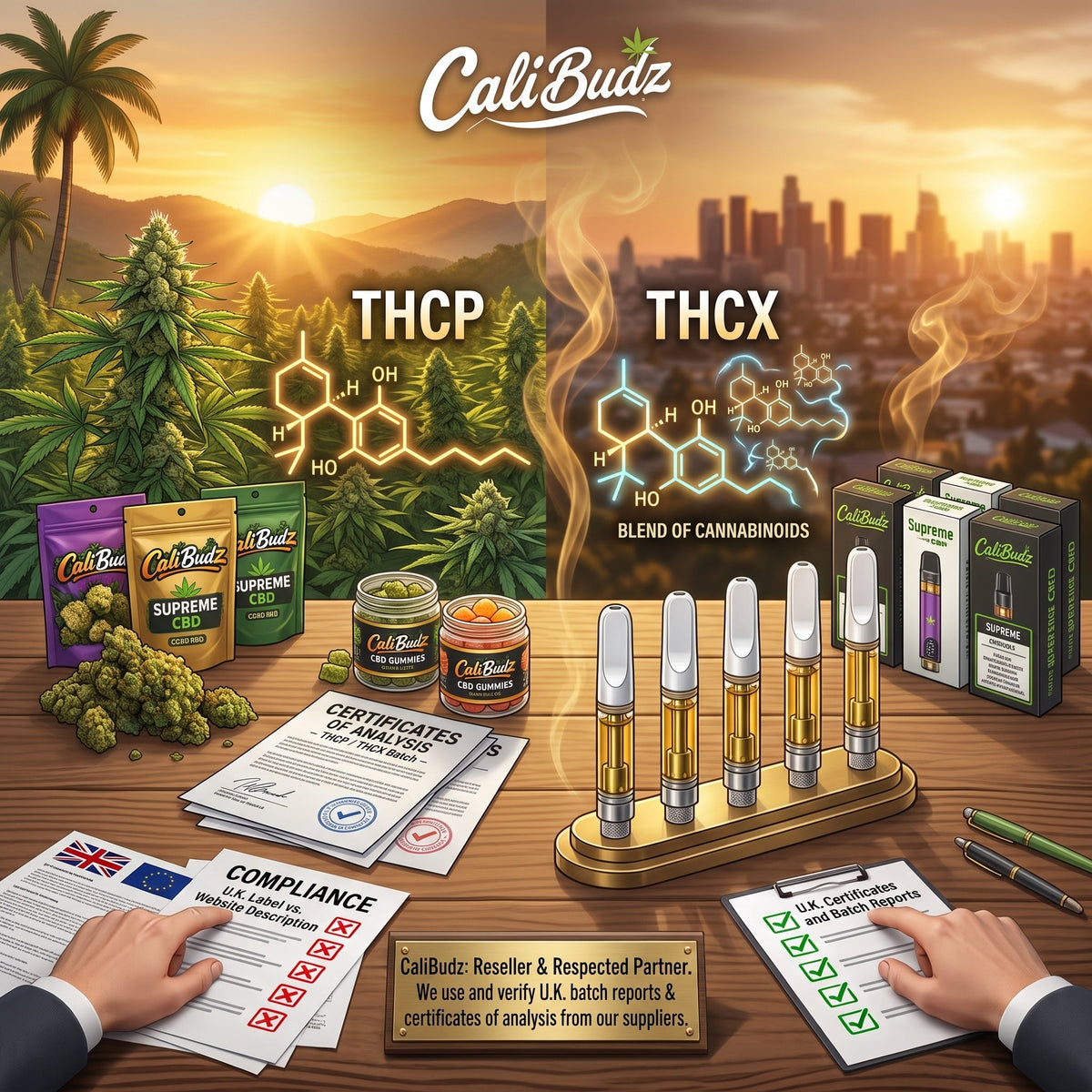
Although their names look similar, they do not describe the same type of ingredient. THCP is the name of a specific cannabinoid, while THCX is generally used as a commercial name for a blend of cannabinoids.
## What is THCP?
THCP—short for tetrahydrocannabiphorol—is an individual cannabinoid with its own identifiable chemical structure.
Researchers first reported isolating naturally occurring Δ9-THCP from *Cannabis sativa* in 2019. It is structurally related to THC but has a longer molecular side chain.
Early laboratory and animal research found that THCP displayed a greater binding affinity for certain cannabinoid receptors than delta-9 THC. This finding is sometimes described online as meaning that THCP is “33 times stronger than THC,” but that is misleading. Greater receptor-binding affinity does not establish that its effects in people are 33 times stronger.
Human research into THCP remains extremely limited. Its complete effects, appropriate quantities, interactions and long-term risks have not been established through robust clinical studies.
In simple terms:
- THCP is a specific chemical compound
- It has an identifiable molecular structure
- It may occur naturally in cannabis in very small quantities
- Research into its effects on humans remains limited
## What is THCX?
Unlike THCP, **THCX is not a consistently defined scientific name for one particular cannabinoid**.
Within the commercial cannabinoid market, THCX is generally used as a product or formulation name for a blend containing two or more cannabinoids. The precise blend can differ between suppliers, manufacturers and individual products.
This means there is no single universal THCX formula. One product described as THCX may have a very different cannabinoid profile from another product using the same name.
Customers should not assume that THCX automatically contains THCP—or any other particular cannabinoid—unless that ingredient is specifically identified in the product information and supporting certificate of analysis.
In simple terms:
- THCX is usually an industry or commercial term
- It commonly describes a blended cannabinoid formulation
- Its composition can vary from product to product
- The label, batch report and certificate of analysis must be checked to establish what a particular product contains
## THCP and THCX compared
| THCP | THCX |
|---|---|
| A specific cannabinoid | Generally a commercial name for a cannabinoid blend |
| Has an identifiable chemical structure | Does not have one universally accepted formula |
| Can be individually measured in laboratory analysis | Must be understood by reviewing every ingredient in the blend |
| Early scientific research is available | Research cannot be generalised without knowing the exact formulation |
| Should appear as an individual compound on suitable documentation | The cannabinoids making up the blend should be identified separately |
## Why certificates of analysis matter
A product name alone cannot tell a customer everything about its contents—particularly when a term such as THCX is used.
A batch-specific certificate of analysis may help identify:
- Which cannabinoids were detected
- Their measured concentrations
- The batch to which the results relate
- The testing method and laboratory
- Whether other substances included within the test panel were detected
CaliBudz does not manufacture, formulate or fill these products. We operate as a reseller and rely on established UK suppliers to provide product details, batch reports and certificates of analysis. We use the information supplied to prepare our website descriptions.
If you would like information about the documentation available for a particular product, please contact us before purchasing or using it.
## Legal status and responsible purchasing
“Hemp-derived” does not automatically mean that a cannabinoid or finished product can lawfully be possessed or supplied in the United Kingdom. The legal position depends on the actual chemical composition of the product and how the relevant legislation applies to it.
The Home Office states that several cannabinoids and cannabinol derivatives are controlled substances. Products may therefore require product-specific legal assessment, regardless of the terminology used on their packaging.
A marketing name, supplier statement or certificate of analysis does not by itself establish legal compliance. CaliBudz works with its UK suppliers and professional advisers to review the products and information provided to us.
## Please check the individual product
THCP and THCX should not be treated as interchangeable terms.
THCP refers to one identifiable cannabinoid. THCX normally refers to a blend whose contents may vary. Customers should always read the complete product description, current label and available batch documentation rather than relying on the product name alone.
If anything appears unclear or inconsistent, please do not use the product. Contact CaliBudz and allow us to check the relevant information with our supplier.
*This article is provided for general education only and does not constitute legal or medical advice. No statement in this article should be interpreted as a claim that a product diagnoses, treats, prevents or cures any medical condition.*